
Overview
Climbing Everest at an altitude of 8,848 meters is a great dream for many. With this journey, we will get as close as possible! Reaching the Everest Base Camp, we will find ourselves at the foot of the highest mountain on Earth. The Everest Base Camp Trek offers not only the thrill and experience of one of the world’s most adventurous hikes but also the opportunity to meet the local Sherpa people and immerse yourself in their rich cultural heritage. During the trip, we will visit the capital of Nepal, Kathmandu, as well as traditional villages such as Namche and Khumjung.
Every day of the journey offers a unique and unforgettable life experience. The adventure begins with a flight from Kathmandu to Lukla. Through the towering Himalayan walls, the plane will land on the small inclined runway of the village. From there, we enter the path toward the “Roof of the World.” The trail crosses Sagarmatha National Park, where you can admire the diverse flora and fauna, glaciers, alpine forests, pastures, high suspension bridges, herds of yaks we encounter along the way, and numerous Buddhist monasteries.
One of these is the famous Tengboche Monastery, where we will experience the serene and harmonious atmosphere of the monks living there. We will also pass through several Sherpa villages and come into contact with the authentic way of life of the Himalayan people.
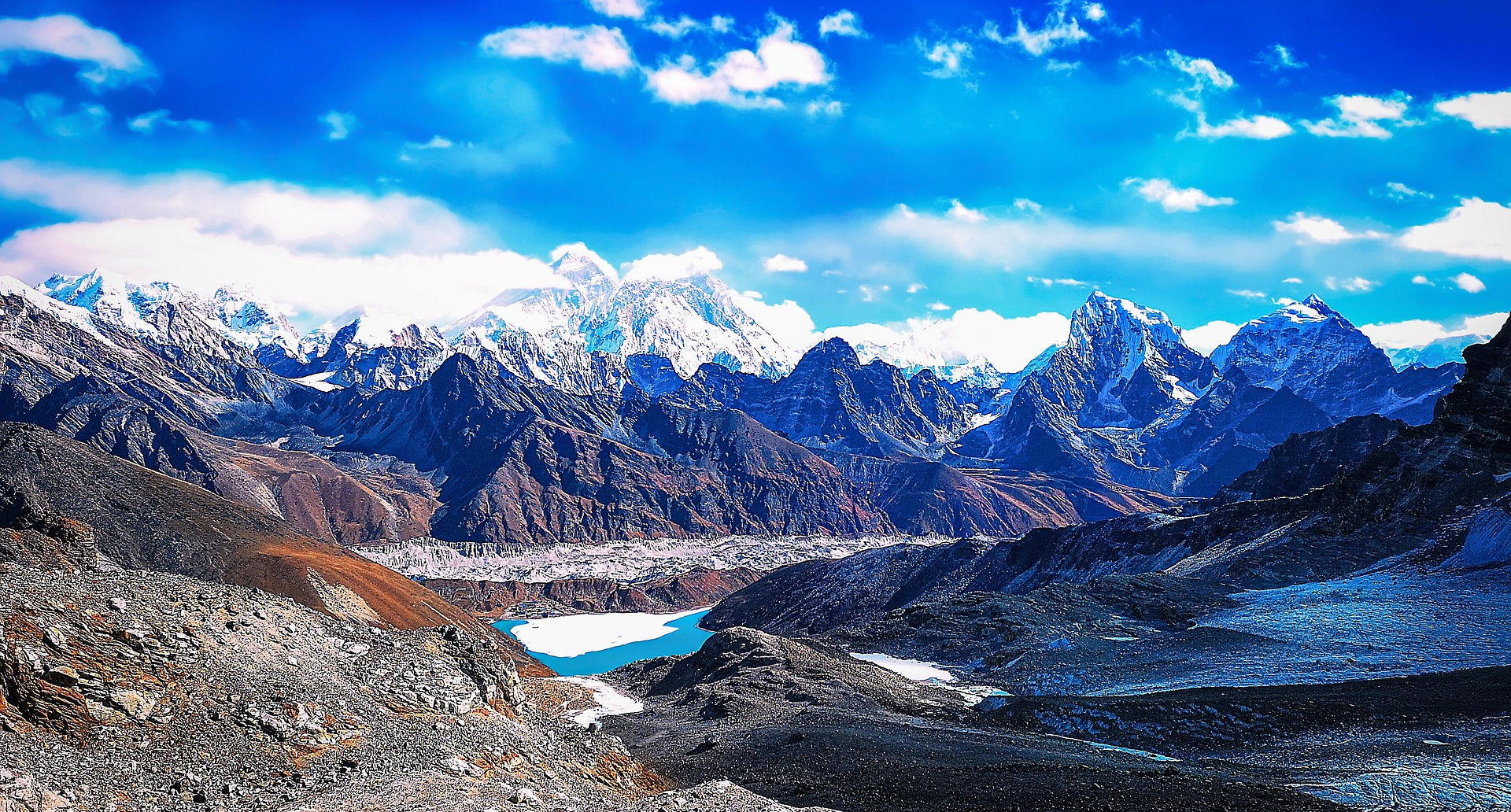
As we ascend higher, the landscape changes dramatically. At Lobuche, we will walk among glaciers, and upon reaching the colorful Everest Base Camp at 5,380 meters, we will be surrounded by mountain peaks with breathtaking panoramic views. Around us are Mount Nuptse, the Khumbu Glacier, and, of course, the majestic Mount Everest, the king of mountains.
The climb to Kala Patthar at 5,500 meters, a well-known peak in the region, will offer stunning views of Everest, the magnificent mountains Nuptse, Ama Dablam, and Pumori, as well as the Khumbu Glacier.
Ηighlights :
– Tengboche Monastery
– Everest base camp
– Khumjung
– Namche
Itinerary
Day 1 Arrival in Kathmandu, transfer to hotel and city tour
Upon arrival at Tribhuvan International Airport, we will meet our guide and transfer to the hotel. Later in the day, we will explore Kathmandu’s medieval Durbar Square, discovering its palaces, temples, and shrines. This is a complex of historic buildings constructed by the kings of Nepal between the 12th and 18th centuries.
Afterwards, we will take a stroll through Thamel, a lively area full of markets, shops, restaurants, and hotels. In the afternoon, we will discuss the technical details of our trek and receive all necessary information for the journey ahead. In the evening, we will enjoy a special welcome dinner accompanied by traditional Nepali dances.
Overnight: Woodapple Hotel and Spa
Day 2 Flight to Lukla (2,850 m) – Trek to Phakding (2,640 m)
Early in the morning, we will transfer to Tribhuvan Airport to take our flight to Lukla (flight duration: approximately 40 minutes from Kathmandu). After breakfast in Lukla (2,850 m), we will begin our trek through scenic villages and soon join the main trail at Churi Kharka.
We will follow the eastern bank of the Dudh Koshi River (“River of Milk”), passing traditional Nepali villages with slate-roofed houses and enjoying views of Kusum Kangaru (5,579 m). We will arrive at Phakding (2,640 m) after 3–4 hours of gentle walking.
Overnight: Phakding Lodge
Day 3 Trek to Namche Bazaar (3,440 m)
Today we will begin our trek towards Namche Bazaar (3,440 m), a more challenging route taking 6–7 hours from Phakding. We will ascend along the western bank of the Dudh Kosi River, passing the tiny village of Toktok. Along the way, we will enjoy views of Thamserku Peak (6,608 m) and reach Benkar (2,710 m), where the cliffs above the village are adorned with huge images of Buddhist deities.
Next, we will cross a colorful suspension bridge and enter Sagarmatha National Park at Monjo (2,840 m). After passing Jorsale, we will follow the riverbank through a pine forest and cross the Dudh Kosi River via a large suspension bridge. We will then continue with a steady 2-hour zigzag climb through dense pine forests, arriving early evening at the vibrant village of Namche Bazaar, one of the most picturesque in the Solu-Khumbu region.
Overnight: Namche Bazaar Lodge
Day 4 Acclimatization Day in Namche Bazaar (3,440 m)
A rest day in Namche Bazaar to help with acclimatization. Optional activities include a visit to the Sherwi Khangba Sherpa Culture Museum, or a day hike to the Everest View Hotel in Khumjung village (3,700 m) and the Khundi Hospital in Khundi village, the first hospital built in the Khumbu region by Sir Edmund Hillary and the Himalayan Trust in 1966.
Overnight: Namche Bazaar Lodge
Day 5 Trek to Tengboche (3,860 m)
Today’s trek lasts 5 to 6 hours from Namche Bazaar. The trail begins with a gentle winding path that offers fantastic views of Everest (8,848 m), Thamserku (6,618 m), and Ama Dablam (6,814 m). After descending to the riverbank, we will undertake a 2-hour ascent to Tengboche. The path goes through rhododendron forests where Himalayan deer, tahrs, and mountain goats can be spotted. Along the rest of the trail, we will enjoy views of Mount Kangtega (6,783 m). Tengboche is also famous for its Buddhist monastery, where we can observe the daily puja, the life of the monks, visit Café Tengboche, and enjoy the spectacular views.
Overnight: Tengboche Lodge
Day 6 Trekking to Dingboche (4,410 m)
Today we will trek for approximately 6–7 hours from Tengboche. The trail begins through conifer and rhododendron forests, leading to the beautiful settlement of Deboche, where we will have a close view of Ama Dablam. Next, we cross a suspension bridge over the white waters of the Imja River. Soon, we will encounter a white stupa (Buddhist temple) that reflects Ama Dablam. The trail then ascends to the village of Pangboche (3,860 m), where the tree line ends. Finally, the path passes through numerous alpine meadows with grazing yaks until we reach the Dingboche valley.
Overnight: Dingboche Lodge
Day 7 Rest and Acclimatization in Dingboche (4,410 m)
Optional acclimatization hike (5–6 hours) to the remote village of Chhukung (4,730 m) and Chhukung Ri (summit) at 5,550 m. The hike offers spectacular views of Island Peak (6,189 m), Amphulapche (5,663 m), Baruntse Base Camp (5,400 m), and the Imja Tsho lake with its white ice.
Overnight: Dingboche Lodge
Day 8 Trekking to Lobuche (4,930 m)
After ascending 150 meters to the main trail, we reach a viewpoint offering spectacular views of Tawachee (6,495 m) and Cholatse (6,440 m). After lunch in Dugla (4,620 m), the trail climbs directly onto the Khumbu Glacier moraine for about an hour, where a series of memorials honor fallen climbers and Sherpas. The path then descends slightly and follows the western side of the valley toward Lobuche. After 4–5 hours of trekking, we arrive at the small settlement of Lobuche at 4,930 meters.
Overnight: Lobuche Lodge
Day 9 Trekking to Gorak Shep (5,160 m) – Afternoon Visit to Everest Base Camp (5,350 m)
Today’s ascent to Gorak Shep (5,160 m) is steeper and rougher as we cross several moraines. Soon, we will see the peak of Pumori (7,145 m). We will also have our first views of Nuptse (7,864 m), Kala Patthar (5,545 m), and Everest. On the right side, we can admire the Khumbu Glacier, a massive frozen river descending the slopes of Everest.
We will arrive at Gorak Shep around midday and trek to Everest Base Camp in the afternoon, making for a total of 6–7 hours of trekking today. Overnight will be at a lodge in Gorak Shep, a semi-permanent settlement at the foot of the Khumbu Glacier, where we can enjoy a warm tea in the shadow of the world’s highest peak.
Overnight: Gorak Shep Lodge
Day 10 Trek to Pheriche (4,240 m)
Early in the morning, we will ascend to Kala Patthar, the “Black Rock,” at 5,545 m. This is a sacred site adorned with Buddhist prayer flags. Here, we will enjoy an incredible 360-degree panoramic view of the Himalayan giants, from Pumori and Lobuche West to Nuptse, Lhotse, and Everest.
Afterward, we will return to Gorak Shep, passing by the viewpoints of the Pumori and Everest ice lakes. Following breakfast, we will trek back to Pheriche (4,240 m) in about 4 hours.
Overnight: Pheriche Lodge
Day 11 Trek to Tengboche (3,860 m)
Today we will start by descending the Imja Khola valley, walking toward the village of Dingboche with its stone-built potato fields, the highest settlement in the valley. The Pangboche Gompa (monastery) is the oldest in the Khumbu region. From there, we will have a gentle ascent to the tiny village of Deboche, passing along stone walls as the trail climbs to Tengboche through a forest of conifers, birches, and rhododendrons.
The unique beauty of Ama Dablam, standing isolated from the other peaks, creates a stunning Himalayan backdrop.
Overnight: Tengboche Lodge
Day 12 Trekking to Namche (3,440 m)
From Tengboche, the trail descends steeply toward the Dudh Kosi River and the village of Phunki, where we will cross the river. Afterwards, we will ascend toward Namche Bazaar, enjoying northern views of Everest, Lhotse, and Nuptse.
Overnight: Namche Bazaar Lodge
Day 13 – Trekking to Lukla (2,600 m)
Today’s trek is approximately 6 hours. We start with a steep descent from Namche Bazaar down to the Dudh Kosi River, then ascend to Monjo, continuing easily through Benkar and Phakding, finishing in Lukla.
Overnight: Lukla Lodge
Day 14 Flight to Kathmandu
After breakfast, we will take a flight (approximately 40 minutes) from Lukla to Kathmandu. Upon arrival at Tribhuvan Airport, we will transfer to the hotel. The rest of the day is free for relaxation or shopping.
Overnight: Woodapple Hotel and Spa
Day 15 Departure to Greece
After breakfast at the hotel, we will depart for our return journey to Greece.
Rates
| Room TypeCostCost | Cost | Early bird booking (until 30/1/24) |
| Double room (Double Bed) | 2.150.00€ | 1.980,00€ |
| Twin room (2 single rooms) | 2.150,00€ | 1.980,00€ |
| Reservations are confirmed upon payment of a deposit (40% of the total price) | ||
What is included in the price:
– Greek tour leader from NomadsPath with experience in Nepal,
– Flight Kathmandu – Lukla – Kathmandu,
– 2 nights in a 3-star hotel in a double room with breakfast in Kathmandu,
– All accommodations during the trekking portion,
– Full board (breakfast, lunch, and dinner) during the trek, with tea and coffee provided throughout,
– Private transfers to and from trekking start and end points, as well as airport transfers,
– ΤLocal professional guides with extensive experience, accredited by the Government of Nepal,
– First aid kit
– TIMS card and National Park permit for the Everest region,
– Adequate insurance covering all staff, including porters,
– Trekking map for each participant
What is not included in the price:
– Airfare to and from Nepal,
– Travel insurance covering trekking (insurance must include emergency medical assistance),
– Nepal visa fee (USD 30 for 15 days, payable upon arrival at Kathmandu airport),
– Personal expenses such as alcoholic drinks, soft drinks, bottled water,
– Meals on the first and last day in Kathmandu,
– Extra costs for hot showers, charging batteries, phone calls, etc.,
– Any costs due to early de,parture or extended stay
– Any expenses incurred in case of hospitalization.
Useful Information
Although the EBC (Everest Base Camp) trek is one of the most beautiful and popular treks, it is demanding and requires good physical fitness from participants.
During your trip, a group first aid kit will be provided.
Make sure you have travel medical insurance that covers rescue and accidents at altitudes above 4,500 meters.
Personal equipment (for trekking):
• Hiking boots
• A pair of sandals
• A few pairs of woolen socks
• A lightweight wool or fleece jacket/sweater
• A down jacket
• A lightweight Gore-Tex shell jacket and lightweight Gore-Tex pants
• A pair of insulated Gore-Tex gloves or ski gloves
• Sunscreen
• One 1-liter water bottle and a water filter
• A few short-sleeve and long-sleeve shirts
• Three pairs of hiking pants (one Gore-Tex, one loose-fit, and at least one extra)
• A backpack
• Headlamp/flashlight (with extra batteries)
• Sun hat
• Personal first aid kit (a group first aid kit will also be provided)
• Personal toiletries (toothbrush, toothpaste, deodorant, soap, toilet paper rolls, bath towel)
People, Population, and Cultural Etiquette
The capital of Nepal is Kathmandu, located in a larger valley known as the Kathmandu Valley. According to a UN survey in 2010, Nepal’s population was 27.8 million (approximately 28 million today). Life expectancy is 68 years for men and 70 years for women.
Due to the great variety of traditional cultures you will encounter in Nepal, it is important to keep certain etiquette rules in mind. At Buddhist sites, be careful to walk clockwise around stupas (sacred prayer structures). Always remove your shoes before entering a private home or a monastery. When entering a temple or monastery, take off your hat before crossing the doorway. If you are in a Tibetan home, do not point the soles of your feet toward people facing you; instead, try to sit with your legs folded.
During meals, you may notice that locals eat with their hands, but only with the right hand. Do not use your left hand to eat or to pass food. Many restaurants provide a place to wash your hands before eating—we recommend that you do the same.
The usual greeting is “Namaste,” with the palms pressed together in a prayer-like gesture, and shaking hands is not common. Something that may seem unusual is a slight side-to-side movement of the head, which indicates agreement—it does not mean “no.”
Cultures are generally traditional, but Kathmandu and Pokhara are quite modern. However, especially for women in both urban and rural areas, it is best to dress modestly. For tourists, the atmosphere is relaxed and it is acceptable not to strictly follow all local dress customs.
Geographical Location
Nepal covers an area of 147,181 square kilometers. It is a landlocked country, nestled between China to the north and India to the south. Although Nepal does not share a border with it, Bhutan lies not far to the east, along with Bangladesh.
Nepal’s topography varies greatly. From the highest point on Earth, Mount Everest, to the wide alluvial plains in the south known as the Terai, the country displays remarkable geographical diversity. In fact, of the ten highest peaks in the world, eight are located in Nepal.
Currency
The official currency of Nepal is the Nepalese Rupee (NRs). Upon arrival at the international airport, you will find two currency exchange counters: one near immigration and another outside the terminal building. It is useful to arrive with some Nepalese rupees already in your pocket in order to avoid possible delays after a long international flight.
In the main tourist areas, there is a large number of exchange offices that accept most major currencies. Credit cards are widely accepted in large cities, but cash is king in rural areas.
Requirements
In order to participate in the trip, all of the following requirements must be met. For any clarification, you may contact us.
– You must have read the detailed itinerary and agree with all the terms described.
– Your passport must be valid for at least 6 months.
– You must have travel insurance (the policy number will be required to complete the booking).
Travel insurance is considered essential for adventure trips, especially those that include multi-day trekking and stays in mountainous areas at high altitude.
Is this trip right for me?
The trekking part of this trip is considered demanding. You will be hiking for 5 to 7 hours each day, so it definitely requires a good level of physical fitness, which can be achieved relatively easily with proper preparation.
Please also keep in mind that you will reach a maximum altitude of 5,500 meters, which may involve the risk of altitude sickness. For this reason, it is strongly recommended to take all necessary precautions, especially at higher elevations, in order to minimize the risk of nausea and other symptoms. Walk slowly and steadily without rushing, and make sure to stay well hydrated at all times.
Be aware that trekking in the Himalayas is not a luxury experience, and this trip is no exception. During the trek, accommodation will be in lodges that are certainly more basic than city hotels. However, they do provide the essential services and amenities for travelers, such as meals and hot water.
Therefore, if you feel comfortable adapting to a simple way of living for a few days
Trip Requirements
Whether you are an experienced hiker or a beginner traveler, you need to be well prepared in order to participate smoothly in this trip. Since you will be walking on uneven and rocky trails for at least 6 consecutive days, hiking 5 to 7 hours per day, we strongly recommend engaging in cardio-focused activities for at least one month prior to the trip.
Prepare and maintain your physical condition with activities such as swimming, hiking, cycling, and jogging, which will help you build the necessary endurance and stamina for the demands of the trek.
Altitude
The maximum altitude we will reach is 5,500 meters. This trip to Nepal has been carefully designed to ensure that you achieve proper acclimatization before reaching high elevations. As you ascend into the Himalayas of Nepal, it is possible to experience symptoms related to altitude. Reaching high altitudes, although exciting, can also be extremely dangerous.
Altitude sickness is a health condition that occurs when the body is exposed to lower levels of oxygen at high elevations. The most common symptoms can appear within a few hours and include nausea, shortness of breath, headache, and reduced physical performance. If you experience any of these symptoms, inform your group members, your guide, or your porter immediately that you are not feeling well. The guides are trained to recognize these symptoms and can provide assistance on the spot. In many cases, it may be necessary to descend to a lower altitude to allow your body to acclimatize properly.
We strongly recommend consulting your doctor regarding this trip and your ability to travel at high altitude. If you are taking any prescription medication, it is also advisable to carry extra supplies, as it may be difficult to find equivalents in Nepal. Speak with your doctor about any vaccinations required for international travel and make sure that your routine vaccinations are up to date.